 | UNTIL |
|---|
Skill-based quiz. Pay per question. Stop when it’s optimal.
Whitepaper v1.0
Date: February 2026
Status: Hackathon MVP (Stacks Testnet)
Author: Shobhit Tiwari
Affiliation: Independent / Hackathon submission
Contact: shobhit141142@gmail.com
Abstract
UNTIL is a skill-based quiz platform where every question is a paid economic decision on the Stacks blockchain. Players top up once in STX, play from an in app credit balance, and earn or lose based on correctness, speed, and critically when they choose to stop. The system uses HTTP 402 Payment Required (x402) and on-chain verification for top-ups and withdrawals; scoring and payouts are deterministic and server authoritative. UNTIL does not issue its own token, does not charge a platform fee, and is designed around optimal stopping theory: players win by stopping at the right moment, not by luck. This document describes the current architecture, tokenomics, credits flow, question system, and a roadmap including scaling (K tiers), subscription tiers, social/challenge modes, AI evolution, quality improvements, streak incentives, governance, programmatic x402, and mainnet deployment.
1. Introduction
1.1 Problem & Vision
Most quiz and trivia apps monetize via ads or flat subscriptions; gameplay and economics are disconnected. UNTIL ties each question to a real economic cost and reward: you pay to play the next question, earn more for answering correctly and quickly, and keep your winnings only if you stop at the right time. The result is a clear, skill based loop: pay → play → decide (continue or stop) → settle.
The vision is to be the reference pay-per-decision experience on Stacks: transparent tokenomics, wallet as identity, and a credits model that minimizes wallet popups while keeping blockchain as the source of truth for money in and out.
1.2 Core Principles
- Wallet = identity. No email, OAuth, or passwords. Stacks wallet (e.g. Leather) is the only auth.
- Payment gates every question. No free plays in paid mode; AI and question delivery happen only after payment (or credit balance) is verified.
- Blockchain = source of truth. Top up and withdrawal are verified on-chain; MongoDB stores users and history but is not the authority for funds.
- Skill-based, not gambling. Outcomes are deterministic (correct/incorrect, time multiplier); no hidden odds, no house edge, no randomness in payouts.
- Optimal stopping. Profit is achieved by stopping at the right moment; continuing past that point is a deliberate risk.
2. Technical Overview
2.1 Stack
- Network & currency: Stacks; currency STX. Current deployment: testnet; mainnet is a stated future milestone.
- Backend: Node.js, Express, TypeScript. MongoDB (Mongoose) for users, runs, credit transactions, and question audit; Redis for challenge and deduplication state.
- Payments: HTTP 402 with x402-style flow; Stacks RPC/API for transaction fetch and verification. Top-up: verify STX transfer to platform address (confirmed + anchored); idempotent by
txId. Withdrawal: debit credits, broadcast STX to user via@stacks/transactions. - Frontend: Next.js (App Router), Tailwind, Stacks Connect / wallet integration; brutalist, readable UI.
UNTIL does not issue a proprietary token. All value is in STX.
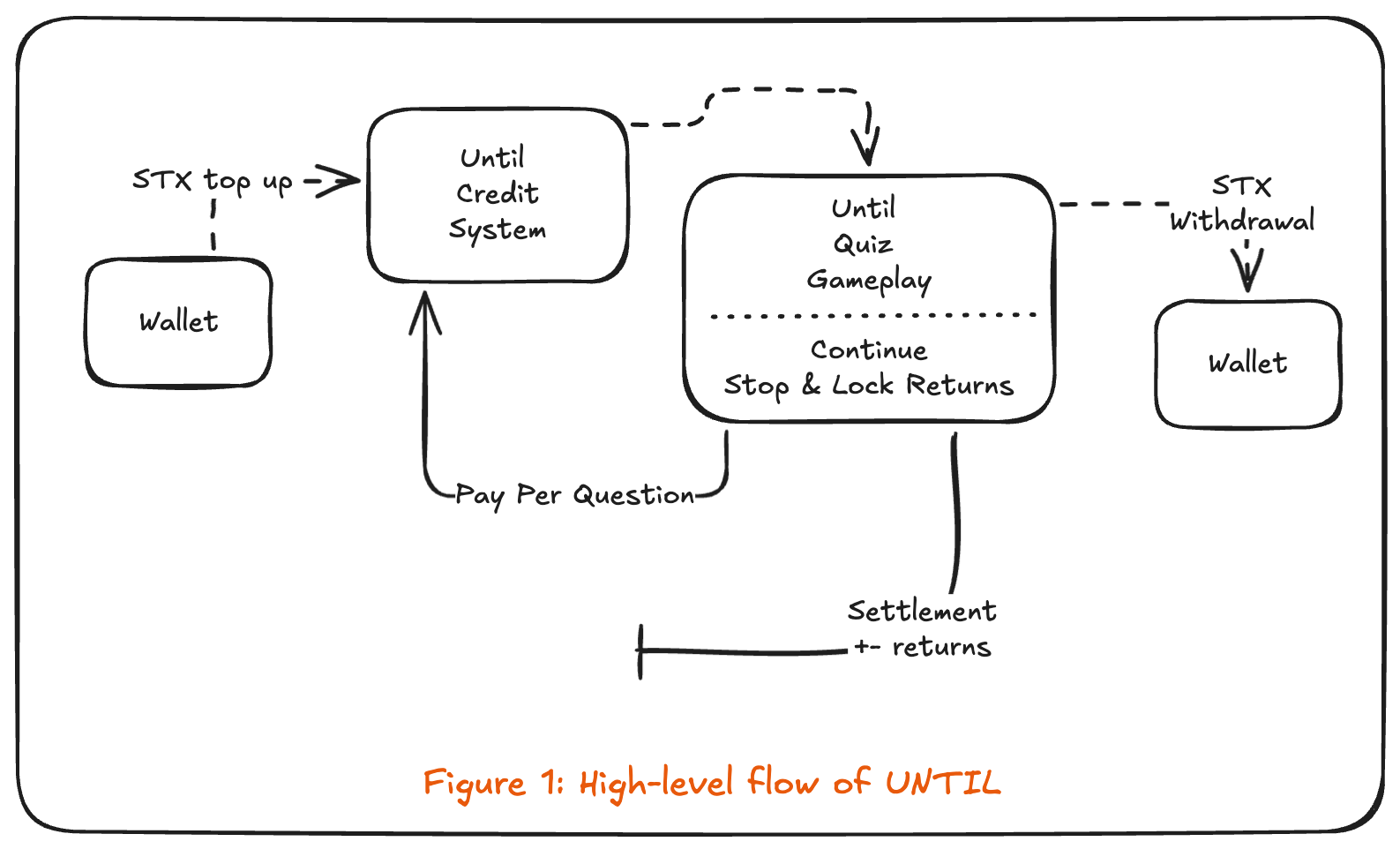
2.2 Payment & Credits Flow
- Top-up: User sends STX to platform recipient (suggested 0.05 STX). Backend verifies tx (exists, success, anchored, recipient match, amount > 0), then credits the sender’s in-app balance. Same
txIdapplied twice returns success without re-crediting and without leaking balance (idempotent). - Play: User spends from credits. Before each question the server checks balance ≥ required cost (for current run or for full run at start). No per-question wallet signature; one top-up funds many decisions.
- Settlement: On stop (after ≥ 4 levels) or wrong answer / timeout, a single settlement runs:
profit = earned − totalSpent; profit/loss is applied to credits; milestone bonus (if any) is added. No immediate on-chain payout at stop; user’s balance is updated in DB. - Withdrawal: User requests withdrawal (min 0.01 STX). Backend debits credits, broadcasts STX to user’s wallet; on broadcast failure, credits are refunded.
Pre start check: starting a run requires balance ≥ total cost for levels 0–9. Mid-run insufficient balance triggers 402 with options to top up or pull out (settle/stop); run history is always persisted.
Figure 1: High-level flow of UNTIL
2.3 Security & Verification
- Correct answers are never sent to the client; scoring is server-only. Run state (correct index, timing) lives in memory with TTL and is cleared when the run ends.
- Answer submission requires
walletAddress; server verifies that the run belongs to that wallet (403 otherwise). - Stacks addresses are validated (SP/ST + 39 chars) on all wallet-accepting endpoints. Top-up and withdrawal amounts are validated; withdrawal is capped by balance.
3. Tokenomics
3.1 Currency & Scaling
- Currency: STX. Network: Stacks (testnet today; mainnet in roadmap).
- Scaling factor K: All monetary amounts (cost, base reward, milestone pool) scale with K. Formula:
actual = base × (K/100). K does not change game logic, EV, or fairness—only the magnitude of stakes.
| K (current / planned) | Role |
|---|---|
| 100 | Default (MVP). Design scale; accessible stakes. |
| 250 | Future: Pro. Higher stakes for engaged players (configurable). |
| 500 | Future: Elite. Highest stakes tier (configurable). |
| 10–25 | Toy/demo. |
| 500–2000 | Real USD-like stakes (opt-in). Cap 2000. |
Current production: K = 100. Future tiers may expose K = 250 (Pro) and K = 500 (Elite) as part of subscription or skill-based tiers.
3.2 Difficulty & Cost
- Levels: 1–10 (0-indexed 0–9 in code). Difficulty increases automatically each question; user does not select difficulty, only continue or stop.
- Minimum before stop: User must complete at least 4 levels before the “Stop & lock result” action is allowed (early stop via “pull out” when insufficient credits remains available for settlement).
- Cost and base reward (at K=100): 1:1 per level; best-case reward ≈ 1.5× cost (speed multiplier). Base table (STX, K=100):
| Level | Cost (STX) | Base Reward (STX) | Best-case profit (1.5×) |
|---|---|---|---|
| 1 | 0.72 | 0.72 | 0.36 |
| 2 | 1.44 | 1.44 | 0.72 |
| 3 | 2.16 | 2.16 | 1.08 |
| 4 | 2.88 | 2.88 | 1.44 |
| 5 | 4.32 | 4.32 | 2.16 |
| 6 | 6.48 | 6.48 | 3.24 |
| 7 | 9.36 | 9.36 | 4.68 |
| 8 | 12.96 | 12.96 | 6.48 |
| 9 | 17.28 | 17.28 | 8.64 |
| 10 | 22.32 | 22.32 | 11.16 |
Early levels are low-cost; later levels are riskier. Infinite play is economically irrational.
3.3 Earning & Time
- Time limit: Every question has a 30-second cap. Answer after time counts as wrong (run ends; earned so far kept; current level cost lost).
- Time multiplier (deterministic buckets):
ratio = solveTime / 30.
| Ratio | Multiplier |
|---|---|
| ≤ 60% | 1.5× |
| 60–90% | 1.2× |
| 90–100% | 1.0× |
| > 100% (timeout) | Wrong; run ends |
Earned per correct answer: earnedStx = baseRewardStx(level) × timeMultiplier. Total earned = sum over correct answers in the run. No points→STX conversion; amounts are STX directly.
3.4 Settlement & Milestones
- Profit:
profit = totalEarned − totalSpent. No platform fee; net = gross. - Milestone bonus (fixed, no RNG): Pool = 4.5 STX at K=100, scaled by K. Run cap = 10 questions.
- 70% completion (≥ 7 correct): bonus = pool/4.
- 100% completion (10 correct): bonus = full pool.
- Bonus is applied at run end (stop or wrong); server-only.
4. Credits System (Primary UX)
- Start: 0 credits (or existing balance from prior top-up or profit).
- Top-up: One wallet tx to platform address; suggested 0.05 STX; backend verifies and credits (idempotent by
txId). - Play: Costs deducted from credits; no wallet pop per question. Balance must cover required cost before each question (or full run at start).
- Stop / wrong: Single settlement (profit/loss + optional milestone) applied to credits.
- Withdraw: Anytime balance ≥ 0.01 STX; backend debits and sends STX to user wallet.
Constants: MIN_WITHDRAW_STX = 0.01, TOP_UP_SUGGESTED_STX = 0.05.
5. Question System
5.1 Categories (Current)
Curated, skill-based categories; same category for the whole run; difficulty via reasoning depth, not obscurity. Examples: Situational Reasoning, Attention Traps, Mental Shortcuts, Constraint Puzzles, Elimination Logic, Estimation Battles, Ratios in Disguise, Everyday Science, One-Move Puzzles, Patterns and Sequences. Rules: single correct answer, verifiable, no opinions, answerable in ≤ 30 seconds; no pure memorization or trick phrasing.
5.2 Hybrid Model (MVP)
UNTIL supports AI-generated questions but, due to resource limits and the need for consistent quality, uses a hybrid model: static question sets per category/level, with optional AI generation and batching. AI is invoked only after payment/credit check; it never affects scoring or payouts. Question quality and category coverage are explicit areas for future improvement (see Roadmap).
5.3 Quality & Fairness
- Server side sanity checks (confidence, duplicate hash, time bounds, difficulty progression); max regenerations then fallback/refund.
- Correct answer and scoring are server-only; client never receives
correct_indexin production.
6. Why This Is Not Gambling
| Gambling | UNTIL |
|---|---|
| Random outcomes | Deterministic (correct/incorrect, time buckets) |
| Hidden odds | Transparent cost/reward and time multiplier |
| Luck-based | Skill + decision (when to stop) |
| House edge | No platform fee |
| Forced continuation | Player chooses when to stop |
One-liner: UNTIL is a skill-based optimal-stopping system where each paid question is an economic decision; profit comes from stopping at the right moment.
7. Current State (MVP)
- Mode: Solo play only. One player, one run; no sharing or head-to-head yet.
- Monetization: No paid subscription; anyone with credits can play. No Pro/Elite paywall.
- K: Fixed at 100 (configurable via env for operators).
- Network: Stacks testnet.
- Auth: Wallet only; no message signing for withdraw/profile (documented limitation).
8. Roadmap & Future Work
8.1 Scaling Tiers (K)
- Current: K = 100 (default).
- Future: Configurable K per tier: Pro (e.g. K = 250), Elite (e.g. K = 500) for higher stakes, with clear UX and risk disclosure.
8.2 Subscription & Monetization
- Current: No paid plan; credits are the only payment.
- Future:
- Pro plan: One-time or recurring; may be required for the primary credit-based play (e.g. “Pro” unlocks full credit system and higher K).
- Elite plan: Premium tier with additional benefits (e.g. higher milestone weight, exclusive categories, or priority support), to be defined with user base and economics.
8.3 Social & Competitive Modes
- Current: Solo matches only.
- Future:
- Run sharing: Players can share a completed run (e.g. link or embed) so others can view the same sequence (and optionally try the same category/level flow).
- Challenge others: “Challenge with my run”—others attempt the same or a mirrored run; results comparable.
- 1v1 quiz: Head-to-head matches after a substantial user base; format and scoring TBD (e.g. same questions, first-correct or score differential).
8.4 AI & Question Pipeline
- Current: Hybrid (static + optional AI); AI used with guardrails and fallbacks.
- Future:
- Matchmaking / discovery: AI to recommend categories, difficulty, or runs.
- Question generation: Deeper use of AI for unique, high-quality questions within strict rules (single answer, ≤ 30s, no trick).
- Multi-level AI architecture: Layered pipeline (generation, filtering, difficulty tagging, deduplication) to support a consistent, unique, and engaging experience as scale and resources allow.
8.5 Question & Category Quality
- Continuous improvement of question clarity, difficulty calibration, and category design. Investment in content and review processes; possible community or expert input over time.
8.6 Streak & Engagement Incentives
- Current: Milestone bonus only (70% and 100% completion).
- Future: Streak-based incentives (e.g. consecutive correct answers or consecutive profitable runs) alongside the existing milestone pool, with clear rules and caps to keep economics stable.
8.7 Governance & Safety
- Future: Grievance reporting, dispute resolution, and conflict settling (e.g. reporting abuse, contested runs, or support escalations). Policies and tooling to be defined with scale.
8.8 Programmatic x402 Integrations
- UNTIL as a reference implementation for x402 on Stacks. Future work may include:
- Public APIs for paid questions (other apps pay per question via 402).
- Embeddable “pay-per-decision” widgets for third-party sites.
- Templates and docs for developers building x402-powered applications.
8.9 Mainnet & Scaling
- After sufficient testing and audits on Stacks testnet, UNTIL may transition to Stacks mainnet, with appropriate risk disclosure, K and stake limits, and operational safeguards. Scaling of infrastructure, monitoring, and support will follow mainnet launch.
9. Risks & Disclaimers
- Testnet: Current deployment uses testnet STX; value is not mainnet value.
- Smart contracts: Withdrawals are executed by the platform (server-signed txs); no user-facing smart contract risk in the current design.
- Custody: Credits are book entries; platform holds STX for withdrawals. Users should only keep amounts they accept as platform risk.
- Regulation: Applicable law may treat quiz-for-value differently by jurisdiction; no legal advice is intended.
- No guarantee: Past performance, EV formulas, or bonus structures do not guarantee future results; parameters (K, costs, milestones) may change with notice.
10. References
- Stacks: https://docs.stacks.co/
- HTTP 402 Payment Required / x402: payment-gated APIs; UNTIL uses 402 for “pay then get question” and for top-up prompts.
- Optimal stopping: decision-theoretic basis for “when to stop” in sequential decisions with known cost/reward structure.
Document Info
- Version: 1.0
- Date: February 2026
- Status: Hackathon MVP (Stacks Testnet). Living document; roadmap and future work are indicative and may change.
- Author: Shobhit Tiwari
- Affiliation: Independent / Hackathon submission
- Contact: shobhit141142@gmail.com
- Audience: Developers, operators, and stakeholders evaluating UNTIL’s design and evolution.